How WorkoutGen Builds Your Strength Training Program
Five years of work with a certified coach: discover how WorkoutGen builds structured programs, tracks your sessions and adjusts the training that follows.
- WorkoutGen
- personalized training
- strength training
- workout tracking
- machine learning

 WorkoutGen Guides
Five years behind the program on your screen
WorkoutGen builds your strength-training program with a deterministic engine developed around coaching rules, then connects that program to the sessions you actually complete. It does not ask a chatbot to write your workout. That distinction reflects five years of work with Jeremy Tellier, not a prompt added to a generic app.
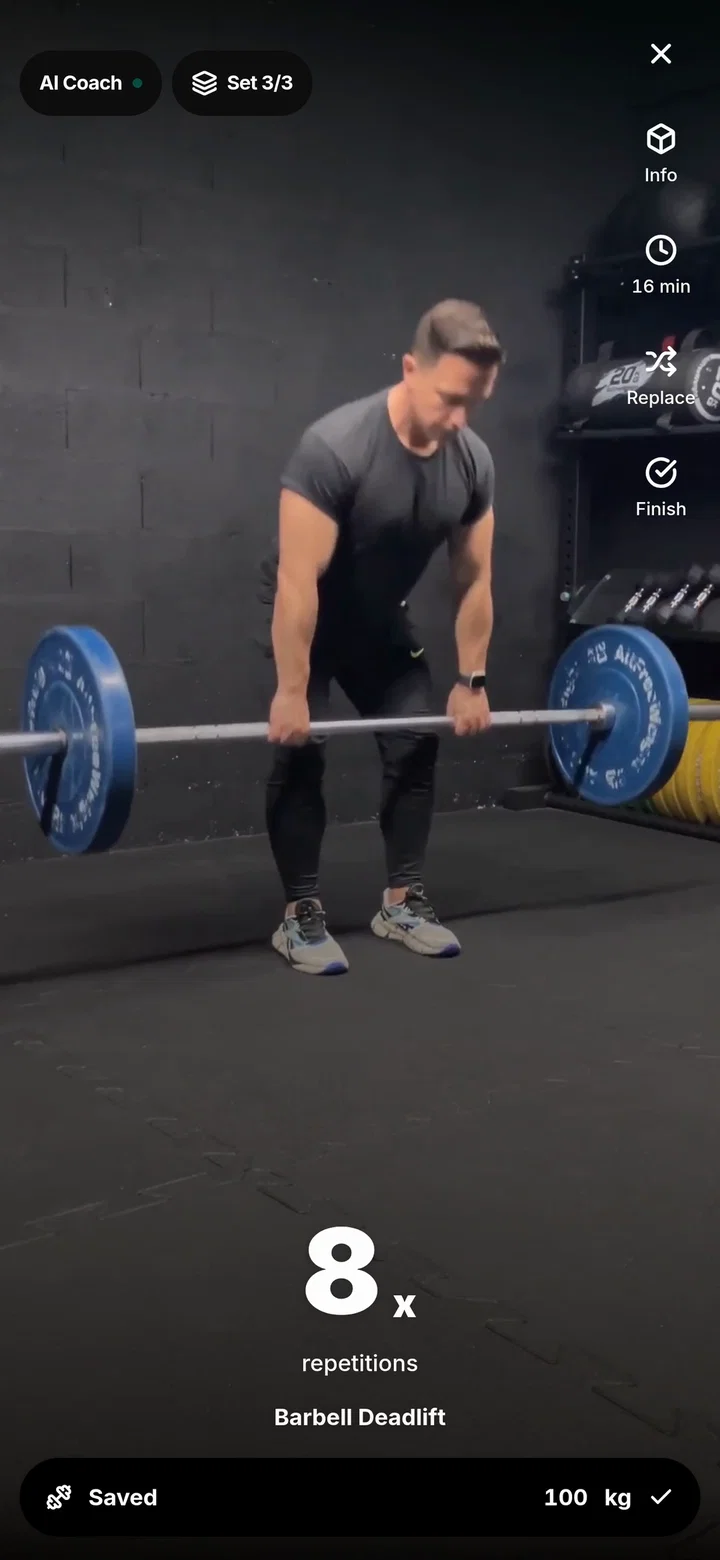
I'm Jean-Baptiste Thery, WorkoutGen's founder and developer. I built the application and its engine; Jeremy, a certified coach, brought his coaching knowledge, checked the sporting consistency and filmed more than 350 exercise demonstrations. WorkoutGen is a French project published by JCODE. Our goal has always been a program people can follow, understand and keep using.
The result is a connected training experience: a structured program, guided sessions and a record of the work you complete. Our collective machine-learning work is progressing alongside that foundation.
Your answers become programming decisions
A useful plan needs more than exercise names. It needs a week that fits your availability, sessions with an order, prescribed work and rest, and a progression that connects them. WorkoutGen's questionnaire supplies inputs to a decision tree built for that job.
| What you bring | What the engine organizes | What you can inspect |
|---|---|---|
| Your goal and training experience | A suitable programming framework and progression rules | The structure of your sessions |
| Your available training days | How training is distributed through the week | Your schedule, including recovery days |
| The time available for a session | A bounded session format | Its exercises, sets and rest periods |
| Completed-session performance | Rule-based adjustments for future training | Your recorded sessions and the training that follows |
These connected decisions make the plan usable through the week. The free personalized program guide explains the starting experience and how to create yours.
Coaching knowledge, research and testable rules
We chose a deterministic engine because its decisions can be inspected and tested. That lets us investigate a programming choice, improve it and check how the change affects other cases.
Research informs the rules, and Jeremy's coaching knowledge helps translate principles into coherent training. For example, the ACSM progression position stand connects programming choices to training status, capacity and goals. A meta-analysis of weekly training volume found an average relationship with muscle growth across the included studies. Neither means that adding sets indefinitely is a good plan for everyone.
The engineering work is deciding how these principles fit together, preserving constraints and checking the resulting sessions. Research informs our programming decisions; Jeremy contributes the coaching judgment needed to apply them. Our AI workout-generator comparison looks at different approaches to planning your training.
A program that stays connected to your training
The program is only the beginning. During a session, the player, rest timer and Jeremy's demonstrations help you follow it. The free tracker records loads, repetitions and durations so that completed work becomes a training history, rather than disappearing when you close the screen.
After a session is completed, WorkoutGen can use objective performance and deterministic rules to adjust future workouts. This is what adaptation means here: responding to recorded training, not rewriting an exercise while you are doing it. Both Classic and Max support this post-session mechanism; Max adds features such as progress charts and personalized load suggestions.
For you, that means your completed sets matter. Recording the work you actually performed builds an accurate history and supplies context for the next programming decision. The tracker connects each session to your longer-term training.
Collective learning: work already under way
Alongside the engine, we are developing a collective machine-learning pipeline. The question is specific: could a bounded, coach-approved parameter setting work better for a particular group of training profiles? The intention is to evaluate useful configurations, not let a model freely invent exercises or rewrite coaching rules.
We have already tested the comparison and selection pipeline successfully on synthetic datasets. Optional, revocable consent enables members to contribute objective completed-session data to this work. The approach separates finding a promising setting from checking it on independent evidence, before considering its integration into the engine.
Today's adaptation remains deterministic while this collective-learning work progresses. The successful dataset tests validate the pipeline's implementation; evaluating benefits for real users is the next challenge. LLMs are themselves a form of machine learning. Our chosen approach focuses on training-specific configurations within the rules built with Jeremy.
Look at what your program actually does
WorkoutGen is available through native iPhone and iPad apps, native Android on Google Play, Windows on Microsoft Store and the installable web app, with one account across supported platforms. The program and core tracker are free; Max is optional. WorkoutGen is a fitness tool and does not guarantee results.
Open your program before your next session and use these four checks to connect the plan to your training:
- Check that the weekly schedule matches the days you selected.
- Look for explicit exercises, sets and rest, not just a motivational paragraph.
- Record the sets you complete, including the loads, repetitions or durations you actually performed.
- Distinguish present features from research still in development.
After completing the session, check that its record appears in your history. Return to that record before your next workout: it lets you compare what was prescribed with what you completed and keep the next session connected to your actual training.
References
- WorkoutGen product and engine reference, updated October 7, 2026.
- ACSM: Progression models in resistance training for healthy adults, 2009.
- Schoenfeld and colleagues: Weekly resistance-training volume and muscle mass, 2017.
See your program take shape with WorkoutGen
Answer the questionnaire, explore your structured training week and track the sessions you complete.
- A structured, personalized program
- 350+ coach-filmed exercise videos
- Free tracking for sets, loads and repetitions
Frequently asked questions
Does WorkoutGen ask a chatbot to write my program?
Does my workout change while I am doing it?
Explore a sample week
-
 Full body
Explore a 3-day full-body week with A and B workouts, exercises, sets, reps, and rest. Then generate your free program.
-
 Upper/lower
Explore a 4-day upper/lower week: two upper-body workouts and two lower-body workouts, with exercises, sets, reps, and rest.
-
 Push pull legs
Explore a 6-day push pull legs week: push, pull, legs, then a second rotation. Each exercise keeps its sets, reps, and rest.
Related tools
-
 Volume
Count your weekly sets for each muscle and compare them with reference guidelines.
-
 RPE and RIR
Connect RPE, reps in reserve and 1RM to adjust your weight.
-