Muscle Memory: Returning to Weight Training at 40
Returning to weight training at 40 after a long break: what muscle memory preserves, your first four weeks, and how to work your way back up to your old weights.
- returning to weight training
- muscle memory
- full body
- progression
- technique

 Bodybuilding Advice
You trained for years, then work, kids, or a move took over your life. Now that you are over 40, you want to get back into it, but where should you start? Returning to weight training after a long break takes a little planning: here is what your body has retained, what has changed, a plan for your first four weeks, and a simple way to work your way back up to your old weights.
What your body retains from years of training
“Muscle memory” is the idea that a muscle that has been trained before can regain its previous level more easily. What you retain most reliably is the movement pattern: you still know how to get under a bar, brace your trunk, and recognize a good rep. These reference points often come back faster than they did when you were starting out.
The research is more nuanced when it comes to strength and muscle mass. In a study by Psilander and colleagues (2019), after a twenty-week training break, participants’ strength remained above their baseline level, while their muscle mass had returned to baseline. When they resumed training, previously trained muscle did not show a clear advantage. Muscle memory therefore seems likely for strength, while its effect on muscle mass is still debated. No one can promise you a timeline: it depends on the length of your break, your training history, and your consistency.
What has changed since your last workout
Your old weights are no longer useful reference points. Your tolerance for training volume has probably decreased, and your recovery may have changed too: a review suggests that age can slow recovery after exercise, with major differences depending on each person’s activity level (Fell and Williams, 2008). Your schedule, sleep, and stress often have a greater impact than they did at 25.
The good news is that your muscles still respond to training. With age, they may respond somewhat less to protein and exercise, but a review highlights the role of physical activity and adequate protein intake in limiting this effect (Aragon et al., 2023). Getting back into training is precisely how you restart that signal.
Your first four weeks: fewer workouts, stay well short of failure
The first month is not about setting records, but about rebuilding the habit and relearning the movements. The WHO recommends that adults perform muscle-strengthening activities involving the major muscle groups at least two days per week (Bull et al., 2020), and that is where this return-to-training program starts.
| Week | Full-body workouts | Sets per exercise | Reps in reserve |
|---|---|---|---|
| 1 | 2 | 2 | 4 |
| 2 | 2 | 2 to 3 | 3 to 4 |
| 3 | 3 | 3 | 3 |
| 4 | 3 | 3 | 2 to 3 |
Each workout includes five or six basic exercises, for example: leg press or squat, lat pulldown, dumbbell or machine bench press, dumbbell Romanian deadlift, seated cable row, and planks. Aim for 8 to 12 reps, with 1 min 30 sec to 2 min of rest. For a complete week in video, check out this 3-day full-body program example.
Work your way back up to your old weights without rushing
Do not load the bar with the numbers you used before. In your first workout, choose a light weight, perform your reps, and ask yourself how many more you could have done: that is your reserve. Adjust the weight from set to set until you find one that leaves you with three or four reps in reserve. The RPE and RIR chart can help you estimate this level of effort.
After that, increase the weight in small increments as long as your reps stay clean and your reserve remains consistent. Your weights may come back quickly during the first few weeks, but keep your reserve and your technique in place. Do not test a one-rep max during the first month. If you want a reference point, the 1RM calculator estimates it from a lighter set. Log every set, including the weight, reps, and reps in reserve: progressive overload only works if you know where you are starting.
Technique, warm-up, and recovery: three habits for getting back into training
Technique first. Start each exercise with a weight you can control through the full range of motion, at a steady pace and without bouncing at the bottom. Guided machines are a useful starting point during the first few weeks, before returning to barbells and dumbbells. Film yourself from the side during a squat or deadlift to check your position, and review our guide to squatting with proper form.
The warm-up. Do five to ten minutes of light cardio, a few movements for your shoulders, hips, and ankles, then two or three progressively heavier warm-up sets for your first exercise. Warm-ups improve performance in most of the situations studied (Fradkin et al., 2010).
Recovery. Leave at least one rest day between two full-body workouts, go to bed at consistent times, and reduce the intensity of your workout after a poor night’s sleep. Fatigue that builds from one week to the next is a signal to ease off, not to push harder. Our guide to rest days covers the key habits in more detail.
Moving to three, then four workouts per week
Add a workout when three conditions are met: your current workouts feel manageable, you recover well between sessions, and your weights are increasing. This rule applies when moving from two to three workouts during the first month, and then from three to four. Change only one thing at a time: one extra workout, more sets, or heavier weights, but never everything at once. After a few weeks of training three times per week, you can move on to our 4-day intermediate weight training program, which alternates upper and lower body workouts.
Common mistakes when getting back into training
- Starting with the weights you used ten years ago.
- Training to failure during the first week.
- Restarting everything at once: four workouts, intense cardio, and a strict diet.
- Rushing through your warm-up because the workout is short.
- Comparing yourself with your 25-year-old self instead of with your workouts from last month.
- Changing programs every two weeks.
- Ignoring recurring pain: consult a healthcare professional if you experience pain or have a medical concern.
Returning to training with WorkoutGen and Jeremy’s method
In the WorkoutGen questionnaire, enter your actual experience, goal, available days, workout duration, and training location. Your program starts from your level, then each completed workout adjusts the difficulty of the next ones, free of charge.
Jeremy’s method, developed by a state-certified coach with a BPJEPS qualification, structures what comes next: cycles in which the workload increases week after week, followed by a lighter week to help you recover. To relearn the movements, every exercise includes a video filmed by Jeremy, along with his technique instructions. And if life takes you away from the gym again, your program picks up where you left off when you return.
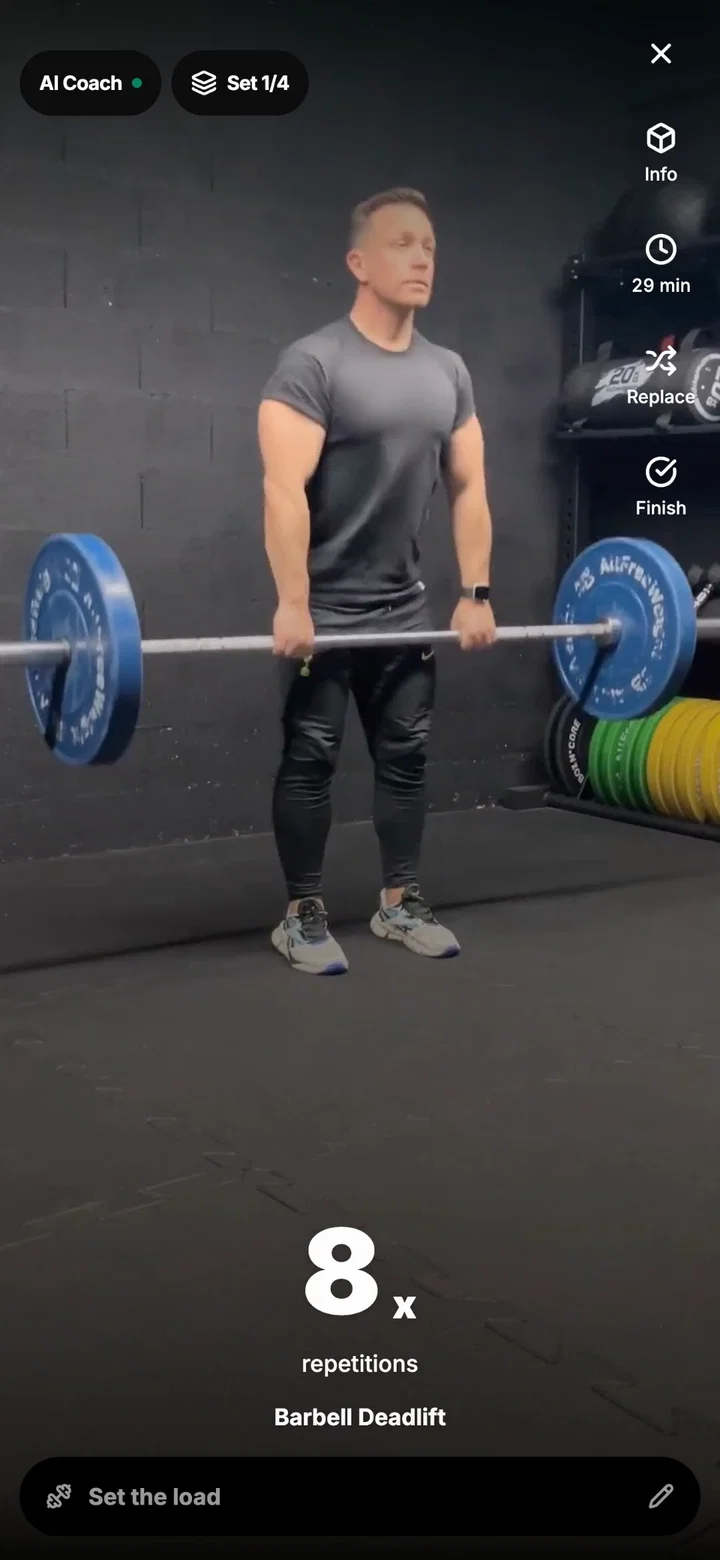
To work your way back up to your old weights, choose a weight you can lift with good form and log every set in the Tracker, free of charge. With WorkoutGen Max, the AI Coach uses this starting weight and then suggests the weight for each set. The details of what is free and what Max adds are in the FAQ. To get started, choose your goal, muscle gain or muscle strengthening, and generate your program.
Start a real, free strength program with WorkoutGen
Generate your free program with 400+ videos. Max adds analysis of your loads, all charts, progress reviews, load suggestions, AI Coach answers, and full customization.
Sources
- Psilander et al., 2019: training, detraining, and retraining, strength and muscle mass (J Appl Physiol)
- Fell et al., 2008: age and muscle recovery after exercise (J Aging Phys Act)
- Aragon et al., 2023: is age-related anabolic resistance inevitable? (Nutr Rev)
- Bull et al., 2020: WHO recommendations on physical activity (Br J Sports Med)
- Fradkin et al., 2010: warm-up and performance, a meta-analysis (J Strength Cond Res)
- Helms et al., 2016: the repetitions-in-reserve scale (Strength Cond J)