Strength Training After 40: Build Strength and Muscle
Strength training after 40: weights, reps, training to failure, recovery, sleep, and deload weeks to keep building strength and muscle.

You've been training for years and, once you pass 40, your lifts no longer improve like they used to. Is it age, or the way you train? Here's what the research shows about strength training after 40, the strategies that still work, and how to organize your week, recovery, and load tracking.
Can you still make progress after 40? What the research shows
Yes, progressive strength training remains effective as you get older. Research on the subject mostly focuses on people older than 40, and the findings point in the same direction. In older adults, higher intensities produce greater strength gains than lower intensities (Steib et al., 2010), and heavy loads remain useful (Borde et al., 2015). The NSCA also recommends progressive, individualized training for older adults (Fragala et al., 2019).
This is not a promise: your progress depends on your training history, consistency, sleep, and nutrition. But age alone does not prevent you from gaining strength or building muscle after 40.
What really changes after 40: recovery, warm-ups, and your schedule
Recovery may take more time, as one review suggests, with substantial differences depending on each person's activity level (Fell and Williams, 2008). Your warm-up deserves more attention, with a few ramp-up sets on the first exercise. And your schedule is often tighter than it was at 25: three workouts you complete every week are better than five workouts every other month.
The strategies that still work: loads, reps, and proximity to failure
Progressive overload. To make progress, your training needs to become slightly more demanding over time. Adding reps or adding weight produces similar results (Plotkin et al., 2022). The simplest approach is double progression: add reps first, then add weight once you reach the top of the rep range. Our progressive overload guide explains it in detail.
Rep ranges. Maximal strength improves most with loads of at least 80% of your 1RM, while muscle growth occurs across a wide range of loads (ACSM, 2026). In practice: 3 to 6 reps on your main lifts when strength is your priority, including squats, bench presses, deadlifts, overhead presses, and rows, 6 to 12 for muscle growth, and up to 15 on assistance exercises.
Proximity to failure. Training to failure does not produce greater strength gains on average (Grgic et al., 2022). In trained men, taking every set to failure even delayed recovery by 24 to 48 hours (Morán-Navarro et al., 2017). Keep one to three reps in reserve on heavy lifts.
Rest periods. For strength, resting more than two minutes between heavy sets may help trained lifters (Grgic et al., 2018).
Organize your week: 3 or 4 workouts, each muscle twice
The ACSM recommends training all major muscle groups at least twice per week (ACSM, 2026). Two simple setups work well:
- three full-body workouts, with a rest day between each one;
- four workouts alternating upper and lower body, like our 4-day intermediate strength training program.
Place your main lifts at the start of your workout, while you're fresh, and spread them across the week: heavy squats and bench presses one day, deadlifts and pull-ups another. If strength is your goal, check out our strength program, built around these lifts.
Recover between workouts and plan deload weeks
Sleep. It is part of your training. Go to bed at consistent times and, after a poor night's sleep, reduce the workload instead of forcing the session. Our guide to rest days for muscle recovery adds more guidance.
Protein. The International Society of Sports Nutrition (ISSN) recommends 1.4 to 2 g of protein per kilogram of body weight per day for most people who train (Jäger et al., 2017). Find your target with the protein calculator.
Deload weeks. A deload week reduces training demands while keeping your exercises in place (Bell et al., 2023). Coaches surveyed by Bell and colleagues reported volume reductions ranging from 25% to more than 50% (Bell et al., 2022). Many programs include a deload after several weeks of progression: move it forward if your workouts decline several times in a row. The deload calculator can help you plan it.
Busy weeks. A small amount of training is often enough to maintain what you have built. According to one review, one workout per week can maintain strength and muscle size in younger adults if the load remains high, while older adults seem to need about two workouts to maintain muscle mass (Spiering et al., 2021). In one study, one third of the usual training volume was enough for younger adults to maintain muscle mass, but not for adults aged 60 to 75 (Bickel et al., 2011).
Track your loads to know when to increase them
Without written records, you do not know whether you are progressing. Record the weight, reps, and reps in reserve for every set, then compare the same exercise from one week to the next. Increase the weight when you complete the entire rep range with your target number of reps in reserve. For example, on the squat, 3 sets of 4 to 6 at 90 kg: one week you do 6, 6, 5, and the next week you do 6, 6, 6 with two reps in reserve. You then move up to 92.5 kg and work back toward 4 reps. Keep the same weight after a weaker workout. Reduce it by 5% to 10% if you miss the bottom of the rep range for two workouts in a row or if your technique deteriorates. To track your strength without testing a max, estimate your 1RM with the 1RM calculator.
The Tracker and recommended loads in WorkoutGen
In WorkoutGen, you can record your weights, reps, and workout durations for free, along with their history, your consecutive weeks, your best set, and your estimated 1RM. Your program starts from your current level, progresses through cycles with deload weeks, and adjusts to your completed workouts, all for free.
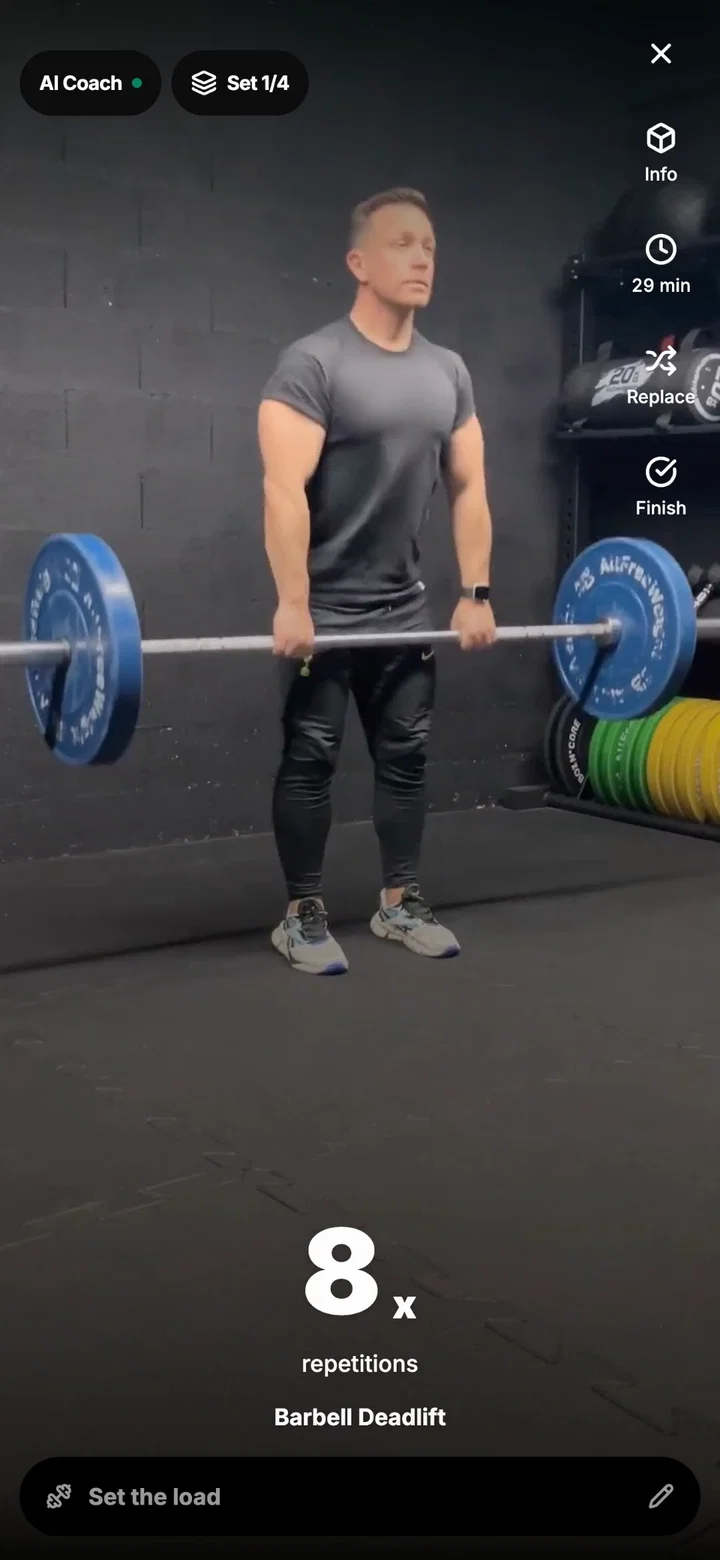
Knowing when to increase the weight remains the trickiest part. With WorkoutGen Max, the AI selects your weight for every set based on your recorded performance. You start with a weight you can lift with good form, then the AI Coach suggests the weight for each set, starting after a few workouts. Max also adds an analysis of every workout by the AI Coach and Tracker dashboards showing your progress and each muscle's recovery on rest days. All the details are in the FAQ.
What about after 50?
Strength training after 50 follows the same principles, and several studies cited here specifically include adults in this age group or older. What changes most is the dosage: a longer warm-up, exercises selected with your joints in mind, heavy loads introduced gradually, and, during busy periods, preferably two workouts per week rather than one to maintain your gains. If you are returning after a long break, start by returning to weight training step by step. Consult a healthcare professional if you have pain or a medical condition.
Start a real, free strength program with WorkoutGen
Generate your free program with 400+ videos. Max adds analysis of your loads, all charts, progress reviews, load suggestions, AI Coach answers, and full customization.
Sources
- Steib et al., 2010: dose-response relationship of strength training in older adults (Med Sci Sports Exerc)
- Borde et al., 2015: dose-response in healthy older adults (Sports Med)
- Fragala et al., 2019: NSCA position statement on strength training for older adults (J Strength Cond Res)
- Fell and Williams, 2008: age and muscle recovery (J Aging Phys Act)
- Plotkin et al., 2022: progressing with weight or reps (PeerJ)
- ACSM, 2026: strength training prescription for healthy adults (Med Sci Sports Exerc)
- Grgic et al., 2022: failure versus non-failure, strength and hypertrophy (J Sport Health Sci)
- Morán-Navarro et al., 2017: recovery after sets taken to failure (Eur J Appl Physiol)
- Grgic et al., 2018: rest duration and strength (Sports Med)
- Jäger et al., 2017: ISSN position stand on protein (J Int Soc Sports Nutr)
- Bell et al., 2023: consensus on deload weeks (Sports Med Open)
- Bell et al., 2022: deload practices among coaches (Front Sports Act Living)
- Spiering et al., 2021: the minimum dose to maintain strength (J Strength Cond Res)
- Bickel et al., 2011: maintaining gains in younger and older adults (Med Sci Sports Exerc)