Intermediate Weight Training Program: 4 Days per Week
A 4-day weight training program for intermediate lifters: exercises, sets, reps, rest periods, and load progression over eight weeks in the gym.

You have been training regularly for several months, your full-body workouts no longer give you enough room for everything you want to work on, and you can get to the gym four times per week. This 4-day-per-week weight training program is designed for this stage: four complete workouts, with their exercises, sets, reps, and rest periods, followed by load progression over eight weeks.
Who this 4-day program is for
It is aimed at an intermediate lifter who wants to build muscle in the gym: at least six months of regular training, solid technique on the squat, bench press, and pulling exercises, and 60 to 75 minutes per workout, including warm-up. The ACSM specifically recommends three to four workouts per week at this level, with four when you separate upper and lower body training (ACSM, 2009).
Returning after a long break? Start with getting back into weight training step by step. Just starting out? Choose the 4-day beginner muscle-gain program. Only three training slots available? Choose the intermediate 3-day version.
Your seven-day schedule
| Day | Workout |
|---|---|
| Monday | Upper body A |
| Tuesday | Lower body A |
| Wednesday | Rest |
| Thursday | Upper body B |
| Friday | Lower body B |
| Saturday and Sunday | Rest |
Do your days fall differently, for example from Saturday to Tuesday? Keep the upper, lower, upper, lower rotation: the same muscle group is never trained two days in a row. If you miss a workout, continue with the next one in order rather than doing two on the same day.
Your four workouts: exercises, sets, reps, and rest
Start each workout with five to eight minutes of light cardio, followed by two or three warm-up sets for the first exercise. Then choose weights that leave you with a few reps in reserve, depending on the week of the cycle, see below: this is RIR, meaning "reps in reserve" (Helms et al., 2016).
Day 1: upper body A
| Exercise | Sets | Reps | Rest |
|---|---|---|---|
| Bench press | 4 | 6 to 8 | 2 min 30 sec |
| Chest-supported machine row | 4 | 8 to 10 | 2 min |
| Seated dumbbell shoulder press | 3 | 8 to 10 | 2 min |
| Machine lat pulldown | 3 | 10 to 12 | 1 min 30 sec |
| Single-arm cable lateral raise | 3 | 12 to 15 | 1 min |
| Rope cable triceps pushdown | 3 | 10 to 12 | 1 min |
Day 2: lower body A
| Exercise | Sets | Reps | Rest |
|---|---|---|---|
| High-bar back squat | 4 | 6 to 8 | 2 min 30 sec to 3 min |
| 45-degree leg press | 3 | 10 to 12 | 2 min |
| Lying machine leg curl | 3 | 10 to 12 | 1 min 30 sec |
| Machine leg extension | 3 | 12 to 15 | 1 min 30 sec |
| Seated machine calf raise | 3 | 12 to 15 | 1 min |
| Plank | 3 | 30 to 45 sec | 45 sec |
Day 3: upper body B
| Exercise | Sets | Reps | Rest |
|---|---|---|---|
| Overhand-grip pull-up, assisted if needed | 4 | 6 to 8 | 2 min 30 sec |
| Incline dumbbell bench press | 4 | 8 to 10 | 2 min |
| Single-arm dumbbell row on bench | 3 | 10 to 12 per arm | 1 min 30 sec |
| Seated machine dip | 3 | 10 to 12 | 1 min 30 sec |
| Rope cable face pull | 3 | 12 to 15 | 1 min |
| Incline dumbbell curl | 3 | 10 to 12 | 1 min |
Day 4: lower body B
| Exercise | Sets | Reps | Rest |
|---|---|---|---|
| Barbell stiff-leg deadlift | 4 | 6 to 8 | 2 min 30 sec |
| Dumbbell static split squat | 3 | 8 to 10 per leg | 1 min 30 sec |
| Machine hack squat | 3 | 10 to 12 | 2 min |
| Lying machine leg curl | 3 | 12 to 15 | 1 min |
| Calf press | 3 | 12 to 15 | 1 min |
| Dynamic side plank | 3 | 10 to 12 per side | 45 sec |
Why alternate upper and lower body instead of training one muscle per day
With this setup, each muscle group is trained twice per week. A meta-analysis found greater muscle growth when each group is trained at least twice per week rather than once (Schoenfeld et al., 2016). With equal volume, frequency has less impact (Schoenfeld et al., 2019), and split and full-body programs produce similar results (Ramos-Campo et al., 2024). The practical benefit: over two sessions, your sets are distributed more effectively and each workout remains high quality.
Volume also matters: muscle growth increases with the number of sets per week, and the first sets matter the most (Schoenfeld et al., 2017). Here, the chest, back, quadriceps, and hamstrings receive 10 to 16 sets per week. Check your own total with the weekly sets per muscle calculator.
Progressing over eight weeks: weights, reps, and deload week
The program uses double progression: at the same weight, add reps until you reach the top of the range on every set, while maintaining the target reps in reserve. Only then increase the weight by the smallest available increment and return to the bottom of the range.
Example for the bench press, 4 sets of 6 to 8 at 60 kg. Workout 1: 8, 7, 7, 6. Workout 2: 8, 8, 7, 7. Workout 3: 8, 8, 8, 8, with two reps in reserve. Next workout: 62.5 kg, and return to around 6 reps. The ACSM suggests increasing the weight by 2 to 10% when you complete one or two more reps than expected (ACSM, 2009), often 2.5 kg on the bar for upper body exercises and 2.5 to 5 kg for lower body exercises. With dumbbells, where the jump from one pair to the next is larger, gain one or two additional reps before changing weights.
| Weeks | Target effort | What to do |
|---|---|---|
| 1 and 5 | 3 reps in reserve | Set your weights and record every set |
| 2 and 6 | 2 reps in reserve | Add reps |
| 3 and 7 | 1 to 2 reps in reserve | Increase the weight where you complete the full range |
| 4 and 8 | Deload week | About half the sets, with slightly lighter weights |
The deload week keeps the same exercises and reduces volume: from 25% to more than 50% among the coaches surveyed by Bell and colleagues (2022). The deload calculator can help you plan it. If you miss the bottom of the rep range for two workouts in a row, or if your technique deteriorates, reduce the weight by 5 to 10% and build back up gradually. After eight weeks, keep your main exercises so you can compare your weights: frequently changing exercises has not shown a clear benefit (ACSM, 2026).
After 40: adjustments you can make
The program stays the same, but a few adjustments are often useful: more warm-up sets for big movements, two or three reps in reserve on the squat and deadlift, and variations suited to your joints, such as the hack squat instead of the barbell squat. Our guide to building strength and muscle after 40 explains these principles in more detail. Consult a healthcare professional if you have pain or a medical condition.
Recovery and substitutions when the gym is busy
The three rest days are part of the program: walking, a little mobility work, and regular sleep are enough. Our rest day guide covers the key habits.
If a machine or bench is occupied, replace the exercise with a movement that serves the same purpose, using the same sets, reps, and rest periods:
- bench press: dumbbell bench press or machine chest press;
- barbell squat: hack squat or Smith machine squat;
- pull-ups: machine lat pulldown;
- chest-supported machine row: close-grip seated cable row;
- stiff-leg deadlift: dumbbell Romanian deadlift.
Start with a conservative weight after each change, and do not compare the weights used for two different exercises.
How WorkoutGen creates and adjusts a 4-day program
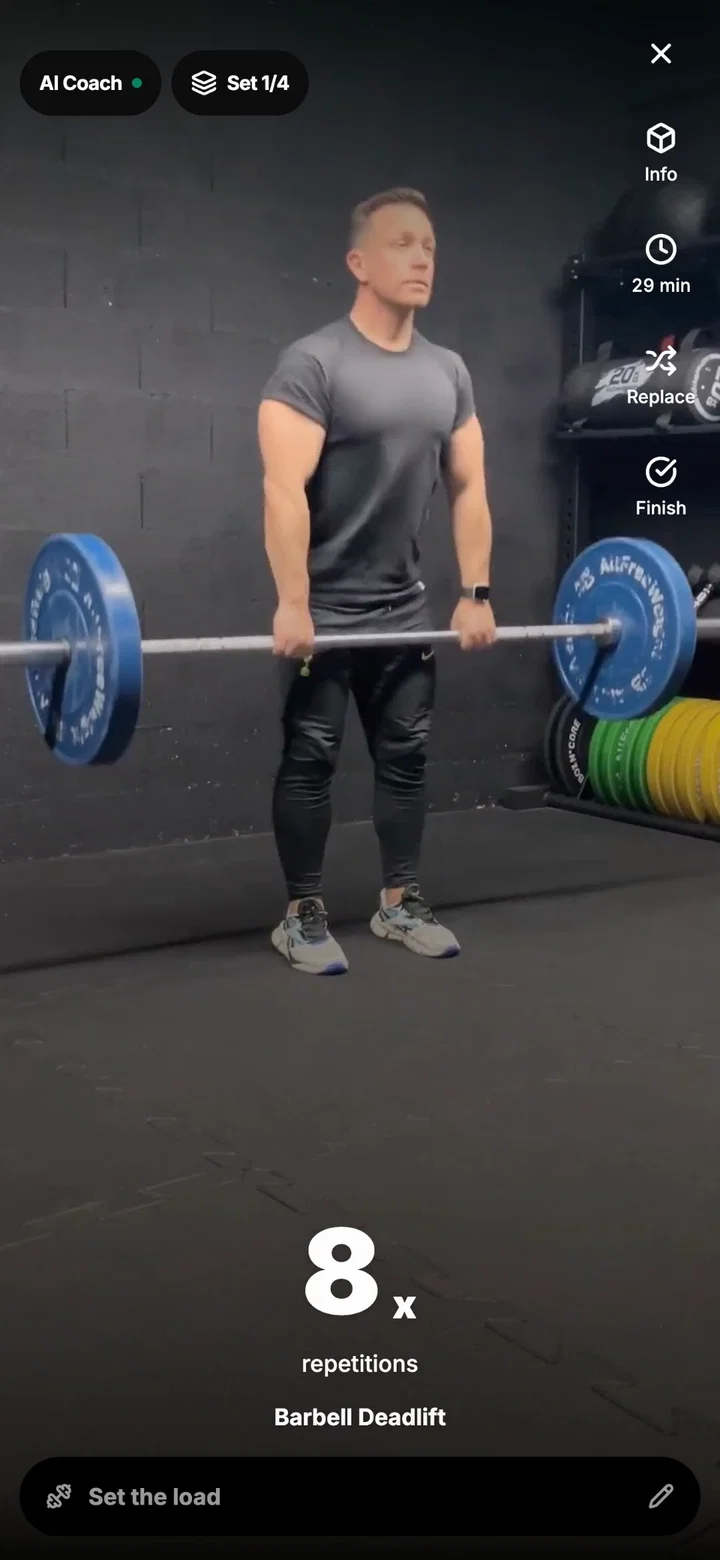
WorkoutGen builds this type of program based on your profile. You enter your goal, level, training location, training days, and workout duration: choose 4 days, and WorkoutGen organizes your workouts. Your program follows training principles validated by Jeremy, a state-certified coach (BPJEPS), and progresses in cycles, with deload weeks. Each exercise has a video filmed by Jeremy, and the workout player times your rest periods. For example, browse this 4-day week generated by WorkoutGen.
The program, videos, workout player, and weight tracking are free, and your completed workouts adjust the rest of your program. With WorkoutGen Max, the AI chooses your weight for each set based on your recorded performance, and the AI Coach analyzes every workout. Everything that is free and everything Max adds is explained in the FAQ, and the muscle-gain program page lets you generate your program.
Start a real, free strength program with WorkoutGen
Generate your free program with 400+ videos. Max adds analysis of your loads, all charts, progress reviews, load suggestions, AI Coach answers, and full customization.
Sources
- ACSM, 2009: progression models in resistance training for healthy adults (Med Sci Sports Exerc)
- ACSM, 2026: resistance training prescription for healthy adults (Med Sci Sports Exerc)
- Schoenfeld et al., 2016: training frequency and hypertrophy (Sports Med)
- Schoenfeld et al., 2019: how many sessions per muscle per week (J Sports Sci)
- Schoenfeld et al., 2017: weekly volume and muscle growth (J Sports Sci)
- Ramos-Campo et al., 2024: split or full body (J Strength Cond Res)
- Helms et al., 2016: the repetitions-in-reserve scale (Strength Cond J)
- Bell et al., 2022: deloading practices among coaches (Front Sports Act Living)