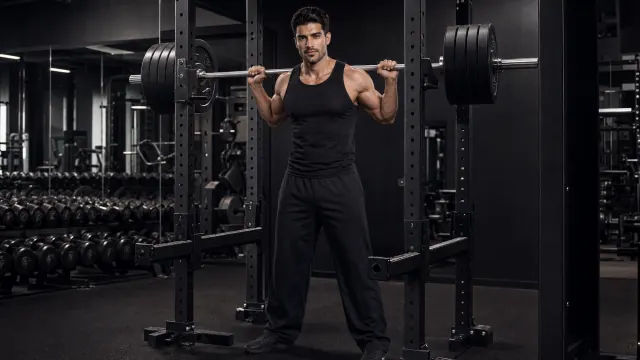
Advanced 2-Day Full-Body Gym Program for Muscle Gain
Train twice a week with an advanced full-body gym program for muscle gain: six exercises, exact sets, reps and rest, plus a Monday and Thursday schedule.

Your advanced 2-day full-body muscle-gain session
Follow this session on the training days shown in the weekly schedule, with controlled repetitions and enough recovery between sessions. Complete 1 round.
-

Bench Press
Sets
- 1 12 Reps Rest 90s
- 2 10 Reps Rest 90s
- 3 8 Reps Rest 90s
- 4 6 Reps
-

Weighted Wide-Grip Pull-Up with Dip Belt
Sets
- 1 5 Reps Rest 180s
- 2 5 Reps Rest 180s
- 3 5 Reps Rest 180s
- 4 5 Reps Rest 180s
-

Unilateral Dumbbell Lateral Raise
Sets
- 1 8 Reps Rest 90s
- 2 8 Reps Rest 90s
- 3 8 Reps Rest 90s
- 4 8 Reps Rest 90s
-

Controlled skater squat
Sets
- 1 6 Reps Rest 150s
- 2 6 Reps Rest 150s
- 3 6 Reps Rest 150s
- 4 6 Reps Rest 150s
-

Unilateral Hamstring Curl
Sets
- 1 8 Reps Rest 90s
- 2 8 Reps Rest 90s
- 3 8 Reps Rest 90s
-

Quadruped Hip Extension
Sets
- 1 6 Reps Rest 20s
- 2 3 Reps Rest 20s
- 3 2 Reps


Who this two-day advanced program is for
This advanced two-day muscle-gain gym program repeats one full-body session on Monday and Thursday. Each workout combines a bench press, a weighted wide-grip pull-up, a single-arm lateral raise, a controlled skater squat, a single-leg hamstring curl and a quadruped hip extension, so the chest, back, shoulders, thighs, hamstrings and glutes are all trained twice a week with exact series, repetitions and rest periods.
It is built for experienced lifters who can only reach the gym twice a week but still want structured hypertrophy work. You should already perform strict bodyweight pull-ups with clear repetitions to spare, bench press with a stable setup and control a single-leg squat without support. If that is not you yet, start with the three-day intermediate hypertrophy program. This is general fitness guidance, not a promise of a particular muscle-gain result.
Your seven-day schedule
| Day | Workout / Recovery |
|---|---|
| Monday | Full-body workout |
| Tuesday | Recovery |
| Wednesday | Recovery |
| Thursday | Full-body workout |
| Friday | Recovery |
| Saturday | Recovery |
| Sunday | Recovery |
Monday and Thursday leave two recovery days after the first workout and three after the second. If you miss Monday, train on Tuesday and move the second workout to Friday rather than training on consecutive days.
Before each workout
Warm up for five to ten minutes, then build up to your first working series of bench press and weighted pull-ups with two or three lighter ramp-up series. Choose loads that leave three clean repetitions available at the end of each listed series. Budget roughly 60 to 75 minutes including the warm-up, both sides of the single-arm and single-leg exercises and equipment changes; treat this as a planning estimate, not a time limit.
Follow the exercise demonstrations and use a stable setup before adding load. Set the rack safety arms for the bench press. Stop a movement that causes pain. If you are unsure whether the session suits you, get individual guidance before continuing.
Build your free muscle-gain program with WorkoutGen
WorkoutGen creates personalized, periodized programs from a 60-second questionnaire and a coach-built decision tree, with exercise videos and workout tracking.
- Personalized to your profile
- Exercise videos
- Tracking in the app
- A free training program
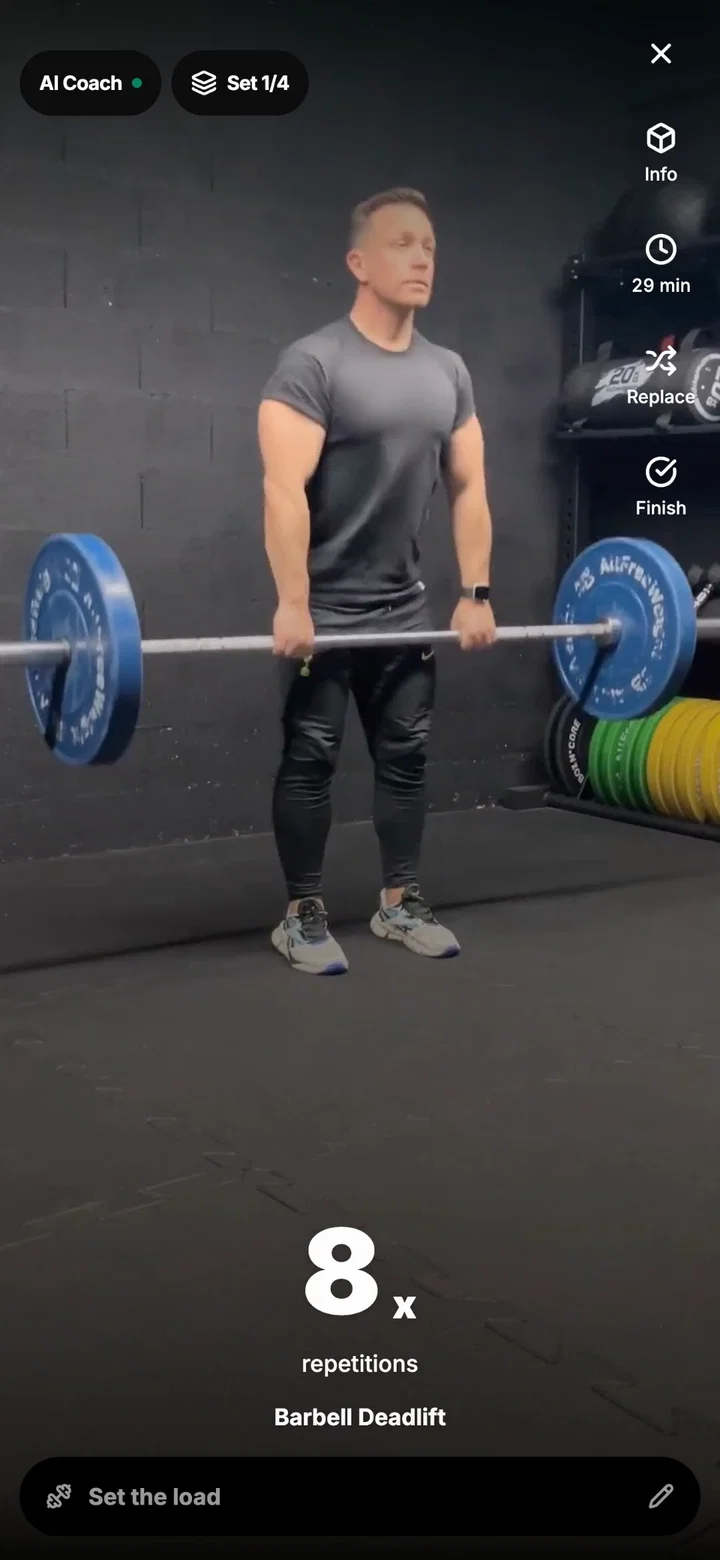
How to run the six-exercise session
Follow the order above and finish an exercise before moving to the next.
- Bench press: 12, 10, 8 and 6 repetitions with 90 seconds between series. Add load as the repetition target falls, but only while three clean repetitions remain available; the six-repetition series is not a maximum attempt.
- Weighted wide-grip pull-up: four series of five with 180 seconds of rest. Hang the load from a dip belt, start every repetition from a controlled hang and avoid swinging. Choose a weight that still leaves three strict repetitions available.
- Unilateral dumbbell lateral raise: four series of eight per arm with 90 seconds of rest. Complete both arms before resting, lift to about shoulder height with a slight elbow bend and lower under control.
- Controlled skater squat: four series of six per leg with 150 seconds of rest. Lower the rear knee toward the floor under control while the front foot stays flat. If you cannot keep three repetitions available, shorten the depth with a pad under the rear knee rather than changing the exercise.
- Unilateral hamstring curl: three series of eight per leg with 90 seconds of rest. Complete both legs before resting and keep your hips in contact with the pad.
- Quadruped hip extension: one rest-pause series per side: six repetitions, a 20-second pause, three repetitions, another 20-second pause, then two repetitions. Keep your lower back neutral and move from the hip rather than arching.
A zero after the last series means that no further within-exercise rest is prescribed, not that you should rush to the next station. Take time to reset your equipment and regain a stable setup.
Why two full-body sessions can work
Every session trains the chest, back, shoulders, thighs, hamstrings and glutes, so each of those areas is worked twice a week. That adds up to eight weekly series of pressing, pulling, lateral raises and skater squats, six of hamstring curls and two rest-pause series of hip extension per side. The press and pull also involve the arms, and skater squats overlap with the glute work, so these numbers should not be added as if every series targeted a separate muscle.
A 2016 meta-analysis on training frequency found that, with weekly volume equated, training a muscle group twice a week produced more hypertrophy than training it once. A 2019 meta-analysis of 25 studies then found no meaningful difference between higher and lower frequencies when weekly volume was matched, including in resistance-trained participants. Together, they suggest that two well-executed full-body sessions are a reasonable structure and that the hard work you complete each week matters more than the number of gym visits. They do not prove that this exact session is optimal for everyone.
Fitting a high weekly volume into two sessions makes each workout longer and can be harder to recover from or to fit into a busy day. Use this plan when your schedule allows two reliable gym appointments, and keep every series productive instead of adding extra sets at the end.
Progress over the next four weeks
In week one, establish repeatable loads for every exercise, including the added weight on pull-ups. Record each completed series, repetition count and load. From week two, increase a load by the smallest available increment only after completing all of its prescribed series with good control and three repetitions still available in two consecutive workouts. On the bench press, move the whole pyramid up together once every series meets that standard.
For the skater squat and hip extension, progress through control: a slower lowering phase, a brief pause at the hardest point or a deeper controlled range, while keeping the listed repetitions. Return to the previous setting if a change makes you miss the targets. The progressive overload guide explains this logic in more detail, and the sleep and muscle growth guide shows how a regular sleep routine supports recovery between the two workouts.
Recovery and substitutions
Keep Tuesday, Wednesday, Friday, Saturday and Sunday as recovery days. Easy walking or normal daily activity is fine if it leaves you ready for the next workout. If performance falls across two consecutive workouts, reduce the working loads and reassess recovery instead of adding sessions.
If equipment is unavailable, choose a familiar substitute that serves the same role: a dumbbell bench press, a heavy lat pulldown, a cable lateral raise, a rear-foot-elevated split squat, another hamstring curl machine or a glute bridge respectively. Re-establish an easy starting load and keep the listed series, repetitions and reserve; substitute loads are not directly comparable with the originals.
Our free personalized-program guide explains how WorkoutGen creates a program from your goal, level and schedule. A free account includes a personalized program, exercise videos and workout tracking. This session remains usable on its own, while the app provides the personalized next step.
Frequently asked questions
Who is this two-day muscle-gain program for?
Which days should I train?
How do I choose the added weight for pull-ups?
How do I count repetitions on the single-arm and single-leg exercises?
How does the rest-pause hip extension work?
Discover more programs
-

Follow a four-day advanced weight-loss gym program with six exact HIIT exercises, eight timed rounds, 60-second round recovery and three rest days.
-

Follow an intermediate three-day gym strength program with six exact exercises, 22 structured series, four recovery days and a simple progression rule.
-

Use an intermediate four-day gym toning microcycle with two working days, two lighter technique days, five exact exercises and three recovery days.
-

Follow a free three-day intermediate hypertrophy gym program with six fixed exercises, exact sets, repetition targets, rest periods and recovery days.


Explore a sample week
-
 Full body
Explore a 3-day full-body week with A and B workouts, exercises, sets, reps, and rest. Then generate your free program.
-
 Upper/lower
Explore a 4-day upper/lower week: two upper-body workouts and two lower-body workouts, with exercises, sets, reps, and rest.
-
 Push pull legs
Explore a 6-day push pull legs week: push, pull, legs, then a second rotation. Each exercise keeps its sets, reps, and rest.
Related tools
-
 Protein
Find your daily protein target based on your body weight.
-
 Volume
Count your weekly sets for each muscle and compare them with reference guidelines.
-
-
 Metabolism
Estimate the energy your body burns at rest using the Mifflin-St Jeor equation.